
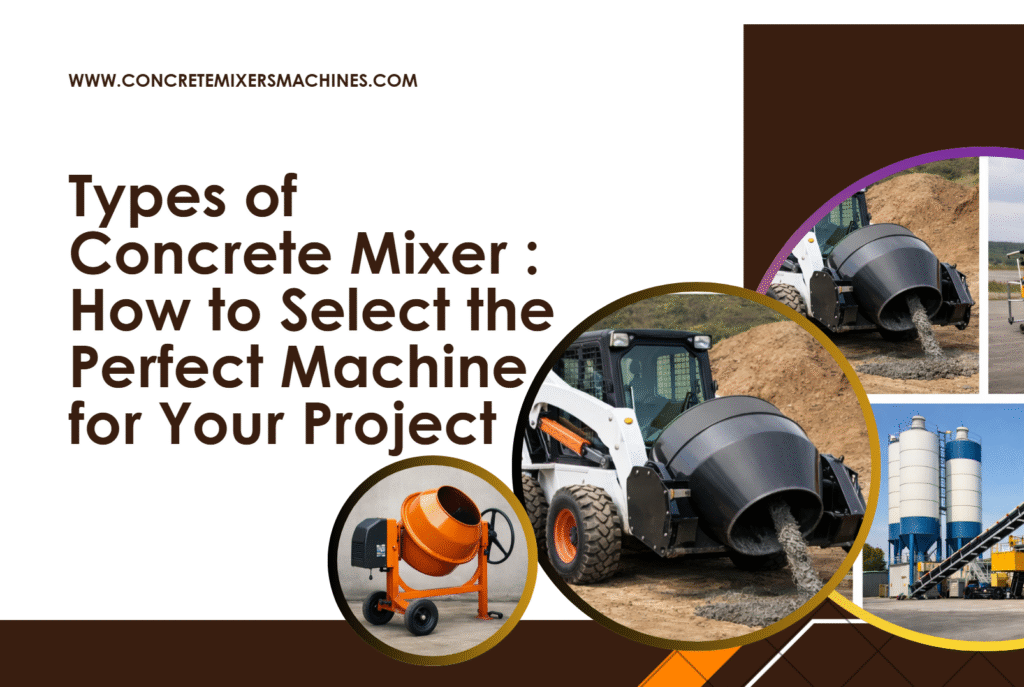
Selecting the right concrete mixing equipment can make or break your construction project. Whether you’re building a residential home, commercial complex, or infrastructure project, understanding the different types of concrete mixer machines is essential for achieving quality results, controlling costs, and maximizing efficiency.
In India’s rapidly growing construction industry, concrete mixers have become indispensable equipment. From small-scale residential projects to massive infrastructure developments, these machines ensure uniform mixing of cement, sand, aggregates, and water to produce high-quality concrete that forms the backbone of durable structures.
This comprehensive guide explores every major type of concrete mixer available in 2025, helping you make informed decisions for your construction needs.
What is a Concrete Mixer Machine?
A concrete mixer is specialized construction equipment designed to combine cement, sand, gravel (aggregates), water, and sometimes additives to create uniform, workable concrete. These machines range from small portable units suitable for minor repair work to large industrial-grade systems capable of producing hundreds of cubic meters of concrete per hour.
Modern concrete mixers save significant time and labor compared to manual mixing methods while delivering consistent quality. They prevent cement lumps, reduce material wastage, and ensure every batch meets the required strength specifications. For any construction project, investing in the right mixer type directly impacts structural integrity, project timeline, and overall costs.
Why Understanding Different Types of Concrete Mixer Matters
Choosing the wrong mixer can lead to:
- Inconsistent concrete quality affecting structural strength
- Increased labor costs and project delays
- Material wastage and higher expenses
- Difficulty handling specific project requirements
- Equipment breakdowns and maintenance issues
The right concrete mixer selection depends on factors like project scale, site conditions, concrete volume requirements, mobility needs, and budget constraints. By understanding the various types of concrete mixer machines available, you can select equipment that optimizes productivity while delivering the quality your project demands.
Primary Categories: Batch Mixers vs. Continuous Mixers
Before diving into specific mixer types, it’s important to understand the two fundamental categories:
Batch Mixers produce concrete in discrete batches, mixing a specific quantity at one time before discharging. These are ideal for small to medium projects where concrete requirements vary or precise mix control is needed.
Continuous Mixers operate non-stop, continuously feeding materials at one end and discharging mixed concrete at the other. These suit large-scale projects requiring steady, high-volume concrete supply without interruption.
Now let’s explore the specific types within these categories.
Types of Concrete Mixer Machines
1. Drum Mixers (Self-Falling Mixers)
Drum mixers are among the most common and widely recognized concrete mixing equipment. These mixers feature a rotating drum (barrel) mounted on a frame, with internal blades or fins that lift and tumble materials during rotation.
How They Work: As the drum rotates, materials are lifted to a height and then fall back down under gravity. This falling action creates thorough mixing. The drum can tilt for easy discharge of the finished concrete.
Types of Drum Mixers:
Tilting Drum Mixers feature a drum that tilts on its axis to pour out mixed concrete. This design minimizes manual effort and speeds up the unloading process, making them popular for small to medium construction projects. They’re particularly useful when you need to quickly move concrete to different locations.
Non-Tilting Drum Mixers have a fixed drum position and require manual labor to unload the mixed concrete. While they lack the convenience of automatic discharge, they compensate with simpler design, easier maintenance, and lower purchase costs. These work well for projects with adequate labor availability and where equipment cost is a primary concern.
Reversing Drum Mixers can rotate their drum in both directions. One direction mixes the concrete, while the reverse rotation discharges it. This design produces highly uniform mixes suitable for both wet and dry concrete. The versatility comes at a higher price point, but the quality justification makes them valuable for projects demanding consistent results.
Best For: Small to medium construction projects, residential building work, site work requiring mobility, projects with varying concrete mix requirements.
Advantages:
- Easy to operate with minimal training required
- Relatively low maintenance requirements
- Mobile and transportable to different work areas
- Suitable for diverse concrete types including mortar
- Efficient mixing of large quantities
Limitations:
- Lower mixing capacity compared to industrial alternatives
- Manual unloading required for non-tilting models
- Less suitable for very large construction projects
Typical Capacity: 100 to 500 liters per batch
Price Range in India: ₹75,000 to ₹2,80,000 depending on capacity and features
2. Pan Mixers (Circular Mixers)
Pan mixers, also called pan-type concrete mixers, feature a circular or round mixing pan mounted horizontally on a sturdy frame with wheels. The mixing action occurs as blades rotate within the stationary pan, creating intensive mixing that produces highly homogeneous concrete.
How They Work: Materials are loaded into the horizontal pan, and rotating blades mounted on a central shaft or along the sides thoroughly mix the ingredients. The circular motion ensures every particle of material is evenly distributed throughout the batch.
Best For: Projects requiring very uniform concrete quality, production of specialized mixes, precast concrete manufacturing, refractory materials, mortar and plaster mixing.
Advantages:
- Produces exceptionally uniform, high-quality concrete mixes
- Excellent for both wet and dry mixes
- Can handle various materials including mortar, plaster, and refractory substances
- Thorough mixing reduces material segregation
- Suitable for producing decorative or specialty concrete
Limitations:
- Lower mixing capacity compared to drum mixers
- Less suitable for large-scale, high-volume projects
- Typically higher initial investment
- May require more maintenance due to complex blade mechanisms
Typical Capacity: 250 to 1000 liters per batch
Price Range in India: ₹1,00,000 to ₹4,25,000
3. Twin-Shaft Concrete Mixers
Twin-shaft mixers represent a significant advancement in concrete mixing technology. These compulsory (forced) mixers feature two horizontal mixing shafts inside a cylinder, with multiple stirring blades attached to each shaft. The shafts rotate in opposite directions, creating an intensive, aggressive mixing action.
How They Work: As the twin shafts rotate, materials are forced through the blades in multiple directions. This creates vigorous mixing that thoroughly combines even difficult materials like stiff concrete, producing superior quality in less time than gravity-based mixers.
Best For: Concrete batching plants, commercial concrete production, high-strength concrete manufacturing, precast component factories, brick production lines, large infrastructure projects.
Advantages:
- Extremely high mixing efficiency and speed
- Produces very uniform, high-quality concrete
- Can handle stiff, dry, or specialty concrete mixes
- Wide application range from standard to high-performance concrete
- Long service life with low failure rates
- Can be integrated with batching plants and production lines
Limitations:
- Higher initial investment cost
- Requires more power consumption
- More complex maintenance requirements
- Typically stationary rather than mobile
Typical Capacity: 500 to 4000 liters per batch
Price Range in India: ₹5,00,000 to ₹21,00,000+
Integration Capability: Twin-shaft mixers excel when combined with aggregate batching machines, cement silos, screw conveyors, and other equipment to form complete concrete batching plants for mass production of commercial concrete. They can also integrate with block forming machines and palletizers to create automated brick production lines.
4. Planetary Mixers (Vertical Shaft Mixers)
Planetary mixers feature a unique mixing mechanism where mixing arms and blades perform a compound movement combining revolution around the pan and rotation on their own axis, similar to how planets orbit the sun. This complex trajectory creates extremely thorough mixing.
How They Work: The mixing blades are mounted on arms that both rotate around their own axis and revolve around the center of the pan. This dual motion creates an intricate mixing pattern that ensures every part of the material experiences intensive mixing action.
Best For: Prefabricated concrete components, concrete bridge frames, concrete wall panel production, refractory materials, ceramic and glass manufacturing, high-performance specialty concrete.
Advantages:
- Achieves superior mixing uniformity and efficiency
- Excellent for viscous, adhesive, or decorative concrete mixes
- Complex mixing trajectory eliminates dead zones
- Produces very consistent, high-quality results
- Ideal for specialized industrial applications
Limitations:
- Higher equipment and operational costs
- More complex maintenance requirements
- Generally lower capacity than twin-shaft designs
- Longer mixing cycles for some applications
Typical Capacity: 250 to 1500 liters per batch
Price Range in India: ₹3,00,000 to ₹15,00,000+
5. Continuous Concrete Mixers
Unlike batch mixers, continuous mixers operate non-stop, with materials continuously fed at one end and mixed concrete continuously discharged at the other. Internal rotating drums or spiral blades keep mixing ingredients as they move through the machine.
How They Work: Screw feeders or conveyors continuously supply cement, aggregates, and water into the mixing chamber. As materials progress through the machine, they’re thoroughly mixed by rotating elements. The finished concrete flows out the opposite end, ready for immediate use.
Best For: Large construction sites requiring steady concrete supply, road construction, dam projects, bridge construction, large-scale infrastructure development, precast concrete manufacturing facilities, industrial projects with extended concrete pours.
Advantages:
- Provides constant, uninterrupted concrete supply
- Eliminates downtime between batches
- Reduces labor requirements significantly
- Ideal for projects requiring massive concrete volumes
- Increases overall project efficiency and speed
Limitations:
- High initial investment cost
- Requires substantial space for operation
- Less suitable for small construction projects
- Limited flexibility for changing mix designs quickly
- Higher power consumption
Typical Capacity: 30 to 120 cubic meters per hour
Price Range in India: ₹15,00,000 to ₹50,00,000+
6. Self-Loading Concrete Mixers
Self-loading mixers are revolutionary machines that integrate four functions in one unit: loading, mixing, transportation, and unloading. These mobile concrete factories eliminate the need for separate loaders, batchers, and transport vehicles.
How They Work: The operator drives the self-loading mixer to aggregate piles, where a front-mounted bucket loads materials into the drum. The mixer can then travel to the pour location while mixing occurs during transport. The drum rotates 270 degrees, enabling unloading from multiple positions without repositioning the vehicle.
Best For: Remote construction sites, road building projects, foundation work, ditch and tunnel construction, sites with limited space or difficult access, projects where batching plants are unavailable or impractical.
Advantages:
- All-in-one functionality saves equipment investment
- Reduces labor costs dramatically
- Produces and delivers concrete on-demand
- Compact design with narrow body and short wheelbase
- Excellent maneuverability on uneven terrain
- Small turning radius ideal for confined spaces
- Eliminates dependence on ready-mix suppliers
- Time and cost-efficient for smaller to medium concrete volumes
Limitations:
- Limited capacity compared to batching plants
- Higher per-unit concrete cost for very large volumes
- Requires skilled operator
- Initial investment higher than simple drum mixers
Types: Self-loading drum mixers and self-loading pan mixers
Typical Capacity: 1 to 6 cubic meters per batch
Price Range in India: ₹12,00,000 to ₹35,00,000
7. Transit Mixers (Ready-Mix Concrete Trucks)
Transit mixers are specialized trucks equipped with rotating drums that transport ready-mixed concrete from batching plants to construction sites while keeping it in a workable, liquid state.
How They Work: Concrete is loaded at a batching plant, and the drum rotates continuously during transport at a slow speed. This gentle agitation prevents the concrete from setting and maintains consistency. The drum reverses rotation at the site to discharge concrete.
Best For: Urban construction projects, sites without mixing facilities, large buildings, road construction, projects requiring consistent quality from centralized batching plants.
Advantages:
- Delivers consistent, quality-controlled concrete
- Eliminates on-site mixing requirements
- Reduces site equipment and labor needs
- Suitable for locations lacking mixing infrastructure
- Available in various capacities (4 to 12 cubic meters)
- Modern models meet BS6 emission standards
Limitations:
- Depends on batching plant proximity
- Transportation time limits
- Higher per-cubic-meter cost for delivered concrete
- Requires accessible routes for truck movement
Typical Capacity: 4 to 12 cubic meters
Price Range in India: ₹31,00,000 to ₹65,00,000
How to Choose the Right Type of Concrete Mixer
Selecting the optimal concrete mixer requires evaluating several key factors:
1. Project Scale and Concrete Volume
Small projects (individual homes, repairs): Drum mixers (100-500 liters) are most cost-effective
Medium projects (multi-unit residential, small commercial): Pan mixers or larger drum mixers (500-1000 liters)
Large projects (infrastructure, commercial complexes): Twin-shaft mixers, continuous mixers, or batching plants
2. Site Conditions
Accessible sites with power: Electric drum or pan mixers
Remote locations: Diesel-powered or self-loading mixers
Confined spaces: Compact self-loading mixers with tight turning radius
Rough terrain: Self-loading mixers with all-terrain capabilities
3. Concrete Quality Requirements
Standard residential concrete: Drum mixers provide adequate uniformity
High-strength or specialty concrete: Twin-shaft or planetary mixers ensure superior quality
Precast components: Planetary or twin-shaft mixers for consistency
4. Mobility Needs
Stationary operation: Pan mixers, twin-shaft mixers, continuous mixers
Frequent relocation: Wheeled drum mixers, self-loading mixers
Transport between sites: Trailer-mounted mixers
5. Budget Considerations
Entry-level: Basic tilting drum mixers (₹75,000-₹1,50,000)
Mid-range: Non-tilting drums, small pan mixers (₹1,00,000-₹5,00,000)
Professional: Twin-shaft, planetary mixers (₹5,00,000-₹20,00,000+)
Industrial: Continuous mixers, batching plants (₹15,00,000-₹50,00,000+)
6. Power Source
Electric motors: Common for sites with reliable power supply
Diesel engines: Essential for remote locations without electricity
Dual options: Some mixers offer both electric and diesel configurations
Cement Mixer Machine Price in India (2025)
Understanding pricing helps budget planning. Here are approximate price ranges for different types of concrete mixer machines in India:
Small Capacity Drum Mixers (100-350 liters): ₹75,000 – ₹1,55,000
Medium Capacity Drum Mixers (400-750 liters): ₹1,60,000 – ₹2,80,000
Pan Mixers (250-1000 liters): ₹1,00,000 – ₹4,25,000
Twin-Shaft Mixers (500-4000 liters): ₹5,00,000 – ₹21,00,000
Planetary Mixers (250-1500 liters): ₹3,00,000 – ₹15,00,000
Self-Loading Mixers (1-6 cubic meters): ₹12,00,000 – ₹35,00,000
Transit Mixers (4-12 cubic meters): ₹31,00,000 – ₹65,00,000
Continuous Mixers (industrial): ₹15,00,000 – ₹50,00,000+
Prices vary based on brand, capacity, features, automation level, and location. Leading Indian manufacturers include Jaypee India Limited, Ajax Fiori, Mixcon India, Safari Construction Equipment, Bharat Machinery Works, and Gamzen Plast, among others.
Key Features to Look for When Buying a Concrete Mixer
Drum/Pan Material: High-quality steel or cast iron for durability and corrosion resistance
Motor Power: Adequate horsepower for your typical batch sizes (5-15 HP for most applications)
Mixing Speed: Variable speed options provide versatility for different materials
Discharge Mechanism: Easy, efficient concrete discharge saves time and labor
Mobility: Wheels, handles, or trailer mounting for portability when needed
Build Quality: Robust construction withstands harsh construction environments
Control Systems: User-friendly controls, digital displays, automated features
Safety Features: Emergency stops, guards, proper electrical protection
Maintenance Access: Easy-to-service components reduce downtime
Warranty and Support: Reliable manufacturer support and parts availability
Maintenance Tips for Concrete Mixers
Proper maintenance extends equipment life and ensures consistent performance:
- Clean after every use: Remove all concrete residue before it hardens
- Lubricate moving parts: Regular greasing of bearings, gears, and chains
- Check electrical connections: Ensure all wiring is secure and insulation intact
- Inspect blades and fins: Replace worn mixing elements promptly
- Monitor oil levels: Regular engine oil changes for diesel-powered units
- Protect from weather: Store under cover when not in use
- Check belts and chains: Maintain proper tension and replace when worn
- Drain water systems: Prevent freezing damage in cold conditions
- Professional servicing: Schedule periodic inspections by qualified technicians
- Keep records: Document maintenance activities for warranty and resale
Safety Considerations When Operating Concrete Mixers
Construction safety is paramount. Follow these essential safety protocols:
- Never operate mixers without proper training
- Use appropriate personal protective equipment (PPE)
- Keep hands, tools, and clothing away from moving parts
- Never reach into operating mixers
- Ensure stable positioning on level ground
- Follow load capacity specifications strictly
- Disconnect power before maintenance or cleaning
- Maintain clear work areas around equipment
- Use proper lifting techniques for heavy materials
- Be cautious of concrete’s alkaline properties on skin
Future Trends in Concrete Mixing Technology
The concrete mixer industry continues evolving with innovation:
Electric and Hybrid Power: Reducing emissions and fuel costs with electric-powered mixers gaining popularity as construction companies prioritize environmental responsibility.
Automation and IoT: Smart mixers with sensors monitoring mix consistency, moisture content, and batch tracking for quality control and documentation.
Self-Cleaning Systems: Advanced designs incorporating automated cleaning mechanisms that reduce maintenance time and increase equipment availability.
Improved Energy Efficiency: Modern designs optimize power consumption while maintaining or improving mixing performance.
Recycled Aggregate Compatibility: Equipment designed to handle recycled concrete aggregates, supporting sustainable construction practices.
Mobile App Integration: Remote monitoring, control, and diagnostics through smartphone applications.
Why Quality Equipment Matters: The Lotus Traders Advantage
When investing in concrete mixing equipment, choosing the right manufacturer makes all the difference. Lotus Traders, operating since 2009 and based in Guwahati, has established itself as a premier manufacturer and supplier of construction equipment throughout Northeast India and beyond.
Specializing in concrete mixer machines and other building construction equipment, Lotus Traders combines years of manufacturing expertise with deep understanding of Indian construction needs. Their product range includes various types of concrete mixers designed for different applications, from small residential projects to large commercial ventures.
What sets Lotus Traders apart:
- Proven Track Record: Over 15 years of manufacturing experience
- Quality Construction: Durable equipment built to withstand demanding site conditions
- Competitive Pricing: Offering excellent value without compromising quality
- Regional Expertise: Understanding of Northeast Indian construction requirements
- Customer Support: Dedicated after-sales service and technical assistance
- Wide Product Range: Complete solutions for construction equipment needs
For builders and contractors in Guwahati and surrounding regions looking for reliable concrete mixer machines, Lotus Traders provides both the equipment quality and local support essential for successful project execution.
Conclusion: Making the Right Concrete Mixer Choice
Understanding the different types of concrete mixer machines empowers you to select equipment that matches your project requirements perfectly. From simple tilting drum mixers for small jobs to sophisticated twin-shaft systems for industrial applications, each mixer type serves specific purposes.
Consider your project scale, site conditions, budget, and quality requirements when making your selection. Remember that the cheapest option isn’t always the most cost-effective when you factor in productivity, quality, and longevity.
Whether you’re building a single home or managing large infrastructure projects, investing in the right concrete mixing equipment ensures quality results, controls costs, and keeps your project on schedule. The concrete mixer you choose today becomes the foundation for structures that will stand for decades.
For personalized guidance on selecting the ideal concrete mixer for your specific needs, consult with experienced manufacturers and suppliers who understand local construction conditions and can recommend equipment that delivers real value.
Ready to invest in quality concrete mixing equipment? Contact Lotus Traders today for expert advice and competitive pricing on a complete range of concrete mixers manufactured right here in India.