
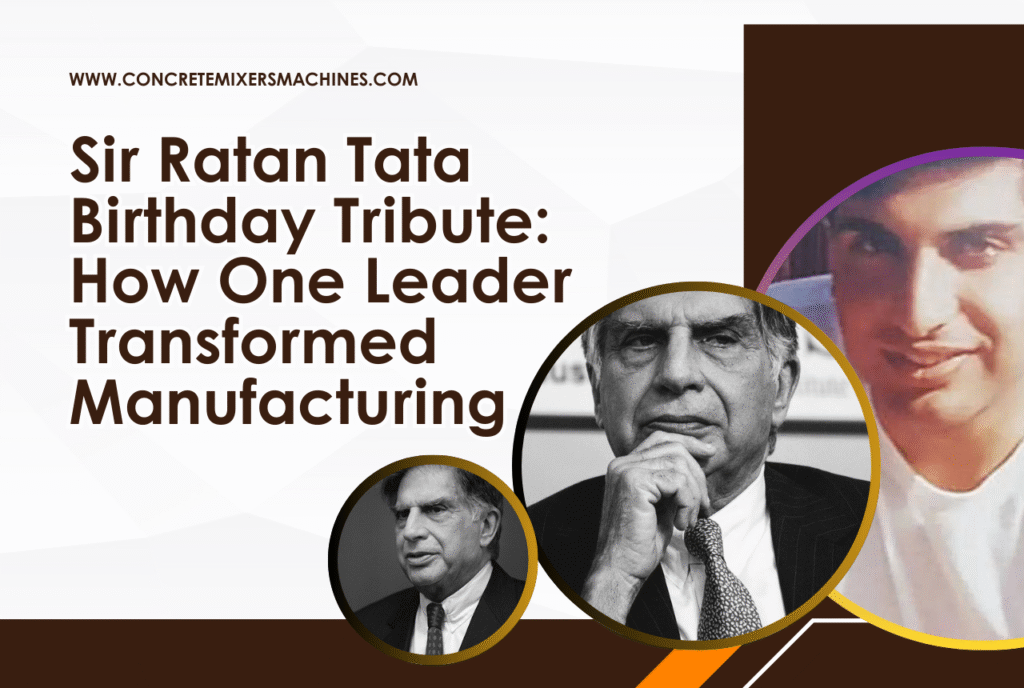
Sir Ratan Tata birthday on December 28th is a date etched in India’s industrial history. Born in 1937, Sir Ratan Naval Tata was a visionary leader whose transformative contributions reshaped not just the Tata Group, but the entire landscape of Indian manufacturing. Though we lost this remarkable industrialist on October 9, 2024, sir ratan tata birthday remains a moment to celebrate a legacy that continues to inspire generations of entrepreneurs, manufacturers, and business leaders across the globe.
Ratan Tata’s journey from working on the shop floor of Tata Steel to becoming the chairman of one of the world’s most respected conglomerates is a testament to dedication, innovation, and an unwavering commitment to nation-building. His contributions to Indian manufacturing have been nothing short of revolutionary, positioning India as a competitive force in the global industrial arena.
Sir Ratan Tata Birthday: The Early Years and Foundation of Excellence
Born on December 28, 1937, in Mumbai into the prestigious Parsi Zoroastrian Tata family, Ratan Tata faced early challenges when his parents separated at age 10. Raised by his grandmother, Lady Navajbai Tata, he grew up in an environment centered around philanthropy and public service.
Sir ratan tata birthday marks the beginning of a journey that would transform Indian manufacturing. After completing his education at various prestigious schools, Tata earned his bachelor’s degree in architecture from Cornell University in 1962, followed by completing the advanced management program at Harvard Business School in 1975. These educational experiences equipped him with both creative vision and strategic business acumen that would later define his leadership style.
Starting from the Ground Up: A Hands-On Approach to Manufacturing
Unlike many corporate leaders who begin their careers in executive positions, Ratan Tata’s entry into the Tata Group in 1962 as part of Tata Steel’s shop floor workforce was his first practical encounter with manufacturing and industrial operations. This decision to start at the bottom was not just symbolic; it demonstrated his belief in understanding operations from the ground up.
His experience working alongside blue-collar workers, shoveling stones and maintaining furnaces at Tata Steel in Jamshedpur, gave him a better appreciation and respect for the family business. This hands-on leadership style would become a hallmark of his management philosophy, allowing him to make informed decisions about modernizing and restructuring Tata’s manufacturing companies.
Sir Ratan Tata Birthday Reminds Us: Transforming Indian Manufacturing
When Ratan Tata assumed chairmanship of Tata Sons in 1991, India was undergoing significant economic liberalization. At this juncture, India was undergoing significant economic liberalization, presenting both challenges and opportunities for businesses. The Tata Group at that time had revenues of approximately five billion dollars and was primarily confined to Indian markets.
What followed was nothing short of a manufacturing revolution. Under his leadership, the Tata Group evolved from a respected Indian conglomerate into a global powerhouse spanning steel, automobiles, technology, and telecommunications.
Steel Manufacturing Excellence
In 2007, Tata Steel acquired Corus Group for 12 billion dollars, making it one of the largest steel producers globally and solidifying Tata Steel’s position on the international stage. This acquisition brought advanced manufacturing practices and technologies into India, benefiting the entire local steel manufacturing ecosystem.
The Corus acquisition demonstrated that Indian manufacturers could compete on the global stage, not just as suppliers of raw materials, but as sophisticated operators of advanced manufacturing facilities.
Automotive Manufacturing Innovation
The automotive sector witnessed perhaps Ratan Tata’s most ambitious manufacturing initiatives. He led initiatives like the Tata Indica, a pioneering attempt at creating a truly Indian car, and launched the Tata Nano, designed for affordability and mass mobility.
In 2008, Tata spearheaded the development of the Tata Nano, marketed as the most affordable car in the world and within easy reach of the average Indian consumer. Though the Nano faced commercial challenges, it represented a bold vision to democratize transportation and showcased India’s manufacturing capabilities.
The crowning achievement came with the acquisition of Jaguar Land Rover from Ford in 2008. Initially met with skepticism, Ratan Tata’s steady leadership and belief in the long-term potential of these ventures proved successful, with JLR becoming a key revenue generator for Tata Motors.
Celebrating Sir Ratan Tata Birthday: Global Acquisitions and World-Class Manufacturing
Ratan Tata’s strategy of global acquisitions was not about empire-building; it was about acquiring technological expertise, manufacturing know-how, and market access that would benefit Indian manufacturing as a whole.
Key acquisitions included:
- Tetley Tea (2000) for 431 million dollars, making Tata one of the world’s largest tea companies
- Daewoo Motors’ truck manufacturing operations (2004) for 102 million dollars
- Corus Steel (2007) for 11.3 billion dollars
- Jaguar Land Rover (2008) for 2.3 billion dollars
Each acquisition brought valuable manufacturing expertise back to India, with advanced manufacturing practices and technologies benefiting the local manufacturing ecosystem.
Technological Manufacturing: Pioneering the IT Revolution
Tata set up Tata Teleservices in 1996 and took Tata Consultancy Services public in 2004, capitalizing on the IT boom. These moves positioned India as a global leader in technology services and software manufacturing, creating hundreds of thousands of high-skilled jobs and establishing India’s reputation as a technology powerhouse.
Sir Ratan Tata Birthday Celebrates: Manufacturing with a Social Conscience
What distinguished Ratan Tata from other industrialists was his approach to manufacturing with social responsibility. The Tata Group, under his leadership, consistently invested in education, healthcare, and rural development, combining profitability with a responsibility to society.
He was committed to reducing social and economic inequality, with plans announced in 2024 to build India’s first indigenous semiconductor manufacturing facility in Assam. This commitment to creating manufacturing opportunities in less-developed regions exemplified his vision of inclusive industrial growth.
The Philanthropic Manufacturer: Building Beyond Business
Around 60-65 percent of the total profit earned by Ratan Tata was donated for charity purposes. This extraordinary commitment to philanthropy was channeled through the Tata Trusts, which owned a controlling stake in Tata Sons.
The Tata Education and Development Trust endowed a 28 million dollar Tata Scholarship Fund at Cornell University to provide financial aid to undergraduate students from India. In 2010, Tata Group companies and Tata charities donated 50 million dollars for the construction of Tata Hall, an executive center at Harvard Business School.
These investments in education ensured that future generations of Indian manufacturers, engineers, and business leaders would have access to world-class training and opportunities.
Manufacturing Innovation and Startups
After stepping down as chairman in 2012, Ratan Tata became an active supporter of India’s startup ecosystem, investing in companies like Ola, Paytm, Urban Company, and Lenskart. This support extended beyond financial investment to valuable mentorship, helping young entrepreneurs scale their businesses and become market leaders.
His investment in manufacturing and technology startups demonstrated his continued belief in innovation as the driver of India’s industrial future.
Sir Ratan Tata Birthday: Awards and Recognition Honoring a Nation Builder
In recognition of his contributions to industry and society, Ratan Tata received the Padma Bhushan in 2000, India’s third-highest civilian honor, followed by the Padma Vibhushan, the country’s second-highest civilian honor, in 2008.
He was appointed Knight Grand Cross of the Most Excellent Order of the British Empire and received the Lifetime Achievement Award from the Rockefeller Foundation. These honors recognized not just his business acumen, but his contributions to nation-building through manufacturing excellence.
The Manufacturing Legacy That Endures
Ratan Tata’s legacy in Indian manufacturing is unparalleled, transforming the Tata Group into a global powerhouse while advancing India’s capabilities in steel, automotive, and technology manufacturing. His focus on innovation, sustainability, and globalization helped Indian manufacturers expand their footprint beyond domestic borders and compete globally.
The manufacturing sector he helped build employs millions of Indians, contributes significantly to GDP, and has positioned India as a serious player in global supply chains. His vision extended beyond profit margins to encompass social development, ethical business practices, and sustainable industrial growth.
Concrete Mixers and Construction Equipment: Following Tata’s Vision
At Concrete Mixers Machines, we draw inspiration from leaders like Ratan Tata who believed in manufacturing excellence, quality, and customer-centric innovation. Just as Tata revolutionized automotive and steel manufacturing, we are committed to providing top-quality concrete mixer machines that meet the exacting standards of modern construction projects.
Our machines embody the same principles that guided Ratan Tata: reliability, efficiency, durability, and innovation. Whether you are working on large infrastructure projects or residential construction, our concrete mixers are designed to deliver consistent performance, reduce operational costs, and contribute to your project’s success.
We understand that in the construction industry, equipment downtime means project delays and increased costs. That is why we focus on manufacturing machines with robust designs, easy maintenance, and long operational life – values that Ratan Tata championed throughout his career.
Lessons for Modern Manufacturers from Sir Ratan Tata Birthday Legacy
Ratan Tata’s approach to manufacturing offers valuable lessons for today’s industrialists:
Start with Understanding: His decision to work on the shop floor taught him the realities of manufacturing operations, enabling better decision-making at the executive level.
Think Globally, Act Locally: His global acquisitions brought international expertise to India while creating employment and growth opportunities domestically.
Innovate for the Common Good: Projects like the Tata Nano showed that manufacturing innovation should aim to solve real social problems, not just maximize profits.
Invest in People: His emphasis on education, training, and employee welfare created a workforce capable of competing globally.
Build for the Long Term: His strategic acquisitions and investments were designed for sustainable, long-term growth rather than short-term gains.
Maintain Ethical Standards: His unwavering commitment to business ethics set new standards for corporate governance in Indian manufacturing.
Sir Ratan Tata Birthday: A Day to Remember, A Legacy to Celebrate
As we observe sir ratan tata birthday on December 28th, we celebrate more than just the birth of an industrialist. We honor a visionary who believed that manufacturing could be a force for social good, that Indian companies could compete with the best in the world, and that business success should be measured not just in profits, but in positive impact on society.
Ratan Tata once said he would like to be remembered as someone who made a difference, nothing more, nothing less. He achieved far more than that. He built a manufacturing empire that became synonymous with quality, transformed how the world views Indian industry, and demonstrated that ethical business practices and profitability can go hand in hand.
For those of us in the manufacturing sector, sir ratan tata birthday serves as an annual reminder of what is possible when vision meets determination, when innovation serves the greater good, and when leaders commit themselves to building not just businesses, but a better future for their nation.
Carrying the Torch Forward
The manufacturing principles that Ratan Tata championed continue to guide modern industrialists. His emphasis on quality over shortcuts, innovation over imitation, and social responsibility alongside profitability provides a roadmap for sustainable industrial growth.
At Concrete Mixers Machines, we strive to honor his legacy by maintaining the highest standards in our manufacturing processes, treating our customers with integrity, and contributing to India’s infrastructure development through reliable equipment that construction professionals can depend on.
Why Sir Ratan Tata Birthday on December 28th Matters to Manufacturing
Sir ratan tata birthday is significant not just as a personal milestone, but as a reminder of the values that built modern Indian manufacturing. December 28th represents the beginning of a life dedicated to industrial excellence, ethical business conduct, and nation-building through manufacturing innovation.
When we celebrate sir ratan tata birthday, we honor:
- His commitment to quality manufacturing that competed globally
- His vision of inclusive industrial growth that created jobs across India
- His belief in acquiring knowledge and technology to strengthen Indian capabilities
- His dedication to using business profits for social development
- His courage to take calculated risks that transformed entire industries
Sir Ratan Tata Birthday Inspiration for Construction and Manufacturing
The construction and manufacturing sectors particularly benefited from Ratan Tata’s vision. His emphasis on infrastructure development, from steel production to automotive manufacturing, created ripple effects across the entire industrial ecosystem.
Today, as we supply concrete mixer machines and construction equipment, we operate in an environment shaped by his contributions. The quality standards he set, the global competitiveness he fostered, and the ethical framework he established continue to guide how we conduct business.
Sir ratan tata birthday reminds us that manufacturing is not just about producing goods; it is about building capabilities, creating opportunities, and contributing to national development. Every concrete mixer that helps construct a building, every piece of equipment that supports an infrastructure project, stands on the foundation that leaders like Ratan Tata built.
Conclusion: Sir Ratan Tata Birthday – A Legacy That Builds Nations
Sir ratan tata birthday on December 28th is more than a date on the calendar. It marks the birth of a leader whose manufacturing innovations, global vision, and ethical standards transformed not just a business group, but an entire nation’s industrial capabilities.
From the steel mills of Jamshedpur to the automotive factories producing world-class vehicles, from telecommunications infrastructure to information technology services, Ratan Tata’s fingerprints are visible across India’s manufacturing landscape. His acquisitions brought global brands under Indian management, his innovations made transportation accessible to millions, and his philanthropy ensured that future generations would have the education and opportunities to continue building India’s industrial future.
As we remember him on sir ratan tata birthday, we celebrate a life dedicated to manufacturing excellence, ethical business practices, and nation-building through industrial development. His story reminds us that great manufacturers build more than products; they build possibilities, opportunities, and better futures for millions of people.
The concrete mixers, construction equipment, and machinery that keep India’s infrastructure projects moving forward stand on the foundation that leaders like Ratan Tata built. Sir ratan tata birthday is an opportunity to renew our commitment to manufacturing excellence, to remember that quality and integrity matter, and to continue the work of building a stronger, more prosperous India through innovative, responsible manufacturing practices.
When December 28th arrives each year, let us pause to honor sir ratan tata birthday not just as a commemorative date, but as a continuing inspiration. Let his legacy remind us that manufacturing can transform nations, that ethical business practices lead to lasting success, and that true leadership means building institutions that outlast individual lifetimes.
Happy Birthday, Sir Ratan Tata. Your legacy continues to inspire and guide us, and your vision of what Indian manufacturing could become remains a beacon for future generations. Every sir ratan tata birthday celebration reaffirms our commitment to the values you championed and the future you helped build.
Frequently Asked Questions:
Q1: When is Sir Ratan Tata Birthday?
Sir Ratan Tata birthday is on December 28th. He was born on December 28, 1937, in Mumbai (then Bombay), India. Although he passed away on October 9, 2024, at the age of 86, his birthday continues to be celebrated as a day to honor his transformative contributions to Indian manufacturing, business innovation, and philanthropy. Many Indians and business leaders commemorate Sir Ratan Tata birthday by reflecting on his legacy of ethical leadership, global expansion, and nation-building through industrial development. December 28th serves as an annual reminder of the values he championed: quality manufacturing, social responsibility, and sustainable business practices that benefit society as a whole.
Q2: What are the Contributions of Ratan Tata to Indian Manufacturing?
Ratan Tata’s contributions to Indian manufacturing transformed India from a domestic-focused economy into a global industrial powerhouse. His major manufacturing achievements include:
Steel Manufacturing: In 2007, Tata Steel acquired Corus Group for $12 billion, making it one of the largest steel producers globally and bringing advanced manufacturing practices to India.
Automotive Innovation: He led initiatives like the Tata Indica, a pioneering attempt at creating a truly Indian car, and launched the Tata Nano, designed for affordability and mass mobility. He also oversaw the acquisition of Jaguar Land Rover from Ford in 2008, bringing premium automotive manufacturing expertise to India.
Technology Manufacturing: Tata set up Tata Teleservices in 1996 and took Tata Consultancy Services public in 2004, capitalizing on the IT boom.
Global Acquisitions: His strategic purchases of Tetley Tea (2000), Daewoo Motors (2004), and other companies brought international manufacturing knowledge and technology back to India, benefiting the entire manufacturing ecosystem.
His focus on innovation, sustainability, and globalization helped Indian manufacturers expand their footprint beyond domestic borders and compete globally. Ratan Tata’s manufacturing legacy created millions of jobs, positioned India as a serious player in global supply chains, and demonstrated that Indian companies could successfully operate world-class manufacturing facilities.
Q3: What Did Ratan Tata Contribute to India?
Ratan Tata’s contributions to India extend far beyond business success, encompassing economic transformation, social development, and nation-building initiatives:
Economic Transformation: Under his leadership, Tata Group transformed from a $5 billion domestic company into a global powerhouse operating in over 100 countries. His strategic acquisitions brought international brands under Indian management, creating thousands of jobs and generating significant foreign exchange earnings.
Manufacturing Excellence: He revolutionized Indian manufacturing by introducing global standards, advanced technologies, and world-class quality practices in steel, automotive, and technology sectors. His acquisitions of companies like Jaguar Land Rover and Corus Steel proved that Indian companies could successfully manage premium global brands.
Social Development: More than 65 percent of Ratan Tata’s shares were donated to charitable trusts that invested in education, healthcare, and rural development. The Tata Education and Development Trust established a $28 million Tata Scholarship Fund at Cornell University, and Tata Group donated $50 million for the construction of Tata Hall at Harvard Business School.
Innovation for Masses: He spearheaded the development of the Tata Nano in 2008, marketed as the most affordable car in the world, demonstrating his commitment to making transportation accessible to average Indians.
Startup Ecosystem: After stepping down from active leadership, Tata became a prominent investor in Indian startups, backing companies such as Paytm, Ola Electric, and Urban Company, nurturing the next generation of Indian entrepreneurs.
Ratan Tata’s multifaceted contributions positioned India as a competitive global economy while simultaneously addressing social inequalities and promoting inclusive growth.
Q4: How Did Ratan Tata Transform Indian Manufacturing Industry?
Ratan Tata transformed Indian manufacturing industry through visionary leadership, strategic global acquisitions, and commitment to innovation and quality. Here’s how he revolutionized the sector:
1. Global Expansion Strategy: When he became chairman in 1991, he faced stiff resistance but implemented policies to consolidate power and build the Tata Group brand. He aggressively pursued international acquisitions including Tetley Tea (2000), Daewoo Motors (2004), Corus Steel (2007), and Jaguar Land Rover (2008), bringing advanced manufacturing technologies and global best practices to India.
2. Technology Integration: Tata Steel’s global expansion brought advanced manufacturing practices and technologies into India, benefiting the local steel manufacturing ecosystem. The acquisitions, particularly of JLR, were initially met with skepticism, but Ratan Tata’s steady leadership proved successful, with JLR becoming a key revenue generator.
3. Innovation Focus: He pioneered indigenous products like the Tata Indica (India’s first homegrown passenger car) and the Tata Nano, demonstrating India’s capability to innovate in both premium and affordable manufacturing segments.
4. Quality Standards: He introduced international quality standards across Tata manufacturing facilities, ensuring Indian-made products could compete globally on quality, not just price.
5. Inclusive Growth: He was committed to reducing social and economic inequality, ensuring manufacturing growth created widespread employment opportunities across India’s diverse regions.
6. Shop Floor Experience: He joined the Tata Group in 1962, starting on the shop floor of Tata Steel, which gave him deep respect for workers and practical understanding of manufacturing operations, shaping his people-centric leadership approach.
Ratan Tata’s manufacturing transformation made India a serious contender in global manufacturing, proving that Indian companies could successfully operate world-class facilities, manage international brands, and compete on innovation rather than just cost advantages.
Q5: Why is Ratan Tata Important to Manufacturing History?
Why is Ratan Tata important to manufacturing history?
Answer: Ratan Tata is important to manufacturing history because he fundamentally changed how Indian manufacturing companies operated, competed, and were perceived globally. His significance extends across multiple dimensions:
Historical Impact on Indian Manufacturing: Ratan Tata served as chairman of Tata Group from 1991 to 2012, during India’s critical economic liberalization period. When he became CEO in 1991, Tata Group was mainly confined to India with revenues of about $5 billion. By his retirement, the company had become a $100+ billion global conglomerate, demonstrating India’s manufacturing potential.
Pioneering Global Acquisitions: In 2000, he acquired London-based Tetley Tea, and in 2007, the Anglo-Dutch steel manufacturer Corus Group. In 2008, he oversaw Tata Motors’ purchase of the elite British car brands Jaguar and Land Rover from Ford. These acquisitions were groundbreaking—they reversed colonial-era dynamics by bringing iconic British and European brands under Indian ownership while preserving their heritage and creating jobs in both countries.
Manufacturing Innovation Legacy: His commitment to affordable innovation through projects like the Tata Nano showed that manufacturing could serve social purposes beyond profit. His development of indigenous products like the Tata Indica demonstrated India’s capability to design and manufacture complex products domestically.
Standards and Ethics: He received the Padma Bhushan in 2000 and Padma Vibhushan in 2008, recognizing his contributions to raising manufacturing standards and promoting ethical business practices that combined profitability with social responsibility.
Lasting Manufacturing Principles: His focus on innovation, sustainability, and globalization helped Indian manufacturers expand beyond domestic borders and compete globally. The story of Ratan Tata is not just one of business success, but of nation-building—creating industries that contribute to the economy, generating employment, and bringing global recognition to Indian manufacturing.
Educational Contributions: He contributed $50 million to construct the Tata Hall Executive Centre at Harvard Business School, ensuring future manufacturing leaders received world-class education.
Ratan Tata’s importance to manufacturing history lies in proving that developing nations could produce global manufacturing leaders, that ethical business practices lead to sustainable success, and that manufacturing excellence combined with social responsibility can transform entire economies. His legacy continues to inspire manufacturers worldwide, particularly in emerging markets seeking to compete globally while maintaining their values and contributing to social development.