
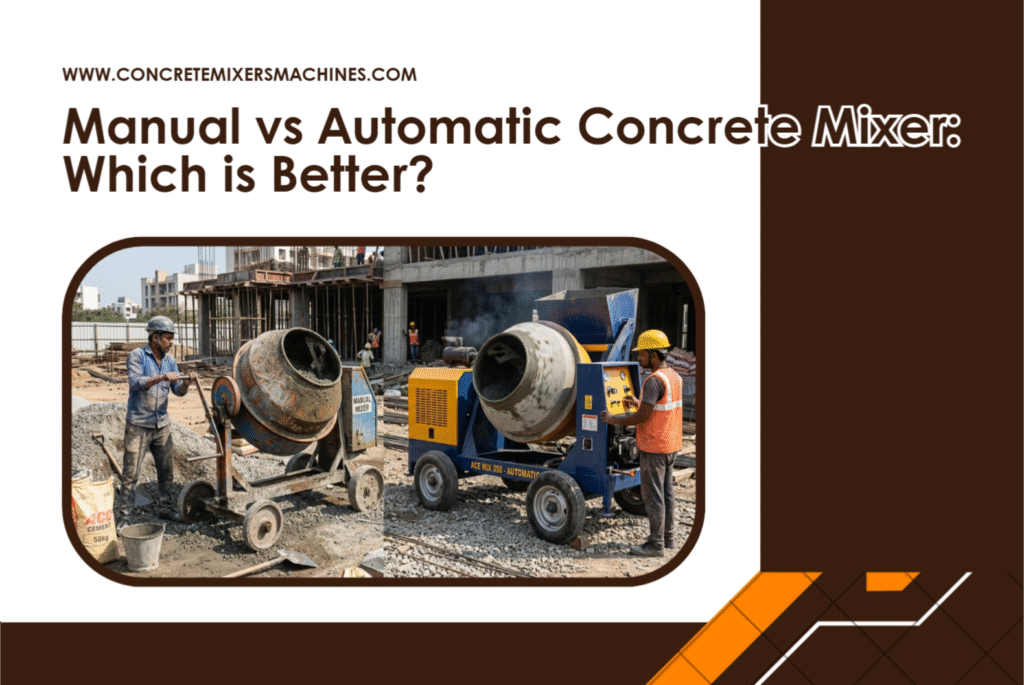
Confused between a manual and automatic concrete mixer? This complete guide breaks down the differences, pros, cons, and which type suits your construction project best.
Choosing the Right Concrete Mixer Matters
Whether you are building a boundary wall, laying a foundation, or working on a large-scale infrastructure project, the concrete mixer you choose directly impacts your output quality, cost, and timeline. One of the most common decisions contractors and site managers face is: manual vs automatic concrete mixer — which one is the right fit?
Both types serve the same fundamental purpose — combining cement, sand, aggregate, and water into workable concrete. But they differ significantly in how they operate, how much labour they need, the consistency they deliver, and how much they cost.
In this guide, we break down everything you need to know about manual and automatic concrete mixers so you can make a smart, informed purchase decision for your next project.
What Is a Manual Concrete Mixer?
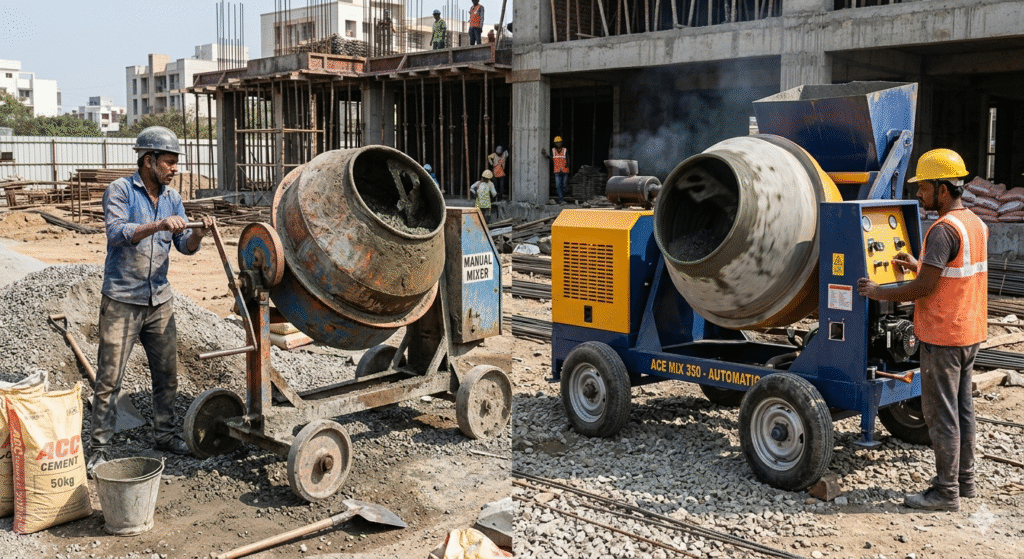
A manual concrete mixer is a machine where the operator controls the loading of materials and often manages the mixing cycle by hand or with minimal automation. The drum rotates using an electric or diesel motor, but the worker is responsible for adding cement, aggregates, and water in the correct proportions.
Manual drum mixers are the most widely used type on small and medium construction sites across India. They are simple, durable, and relatively affordable to purchase and maintain.
Key Features of Manual Concrete Mixers
- Drum rotation powered by electric motor or diesel engine
- Materials loaded manually by the operator
- Available in capacities from 140 litres to 500 litres
- Lightweight and easy to transport between sites
- Minimal electronic components, low maintenance
- Suitable for residential, small commercial, and rural projects
What Is an Automatic Concrete Mixer?
An automatic concrete mixer uses computer-controlled or sensor-driven systems to measure, load, mix, and discharge concrete with minimal human intervention. High-end models can automatically weigh each ingredient, maintain precise water-to-cement ratios, and even adjust for temperature or humidity conditions on site.
According to industry experts at Lotus Traders, automatic mixers use computers to measure and mix everything precisely, making the process faster and reducing material waste significantly.
Key Features of Automatic Concrete Mixers
- Computerised controls for accurate batching
- Automatic loading bucket (hydraulically driven)
- Weighing sensors with less than 2% margin of error
- Self-loading capability on some models
- Higher output capacity, suitable for large projects
- Advanced models include real-time concrete quality monitoring
Manual vs Automatic Concrete Mixer: Head-to-Head Comparison
| Feature | Manual Concrete Mixer | Automatic Concrete Mixer |
| Operation | Operator-controlled loading & mixing | Computer/sensor-controlled process |
| Labour Requirement | 2–4 workers per machine | 1–2 workers per machine |
| Mix Consistency | Depends on operator skill | Highly uniform, precise ratios |
| Output Speed | Moderate (suited for small batches) | High (continuous or large batches) |
| Initial Cost | Low to Moderate | Moderate to High |
| Maintenance | Simple, low-cost | Requires technical servicing |
| Portability | High – easy to move on site | Moderate to Low |
| Best For | Residential & small commercial builds | Large-scale infrastructure projects |
| Power Source | Electric or Diesel | Electric (usually 3-phase) |
Pros and Cons of Manual Concrete Mixers
Advantages
- Lower upfront investment — ideal for small contractors and self-builders
- Easy to operate with minimal training required
- Highly portable and adaptable to remote or off-grid sites
- Simple mechanical design means lower repair costs
- Diesel variants work perfectly where electricity supply is unreliable
Disadvantages
- Mix consistency depends heavily on the operator’s experience
- Higher labour requirement increases per-batch cost over time
- Slower output compared to automated systems
- Not suitable for projects requiring high-volume, continuous concrete supply
Pros and Cons of Automatic Concrete Mixers
Advantages
- Delivers highly consistent, uniform concrete every batch
- Significantly reduces labour costs — saves up to 5 manual workers per unit
- Faster production speed ideal for large-scale or time-sensitive projects
- Reduces material wastage through precise weighing sensors
- Some models are self-loading and self-discharging — minimal human effort needed
Disadvantages
- Higher purchase price — not always justified for small projects
- Requires stable power supply (usually 3-phase electricity)
- Technical maintenance needs qualified service personnel
- Less portable than manual drum mixers
Manual vs Automatic Concrete Mixer: Which One Should You Choose?
The right choice depends entirely on the nature, scale, and budget of your project. Here is a simple framework to help you decide:
Choose a Manual Concrete Mixer If:
- You are working on a residential house, compound wall, or small plot
- Your site is remote with no reliable 3-phase power
- You have a limited budget and need an affordable, durable machine
- You need a portable machine that can be moved frequently
- Labour cost is not a major concern for your project size
Choose an Automatic Concrete Mixer If:
- You are working on roads, bridges, large commercial buildings, or infrastructure
- You need continuous, high-volume concrete supply without interruptions
- Labour cost reduction is a priority over the next 12–24 months
- Concrete quality consistency is non-negotiable for your structural specifications
- You are running a batching plant or precast concrete manufacturing setup
Cost Considerations in India
In the Indian construction market, manual concrete mixers typically range from ₹25,000 to ₹1,20,000 depending on capacity and power source. Automatic or semi-automatic models with advanced batching controls can range from ₹2,00,000 to ₹15,00,000 or more for fully self-loading variants.
While the initial investment in an automatic mixer is higher, contractors running multiple simultaneous projects often recover the cost within 12–18 months through reduced labour expenses and faster turnaround times.
As noted by construction equipment specialists at concretemixersmachines, automatic concrete mixing machines can drastically accelerate production speed and lower labour costs — especially for large-scale projects where manual mixing wastes significant time and manpower.
Why Choose Lotus Traders for Your Concrete Mixer in Guwahati?
At concretemixersmachines.com, powered by Lotus Traders, we have been manufacturing and supplying construction equipment in Guwahati and across Northeast India since 2009. We understand the ground realities of construction in this region — from the terrain to the availability of skilled operators.
Whether you need a reliable manual drum mixer for a housing project in Assam or an advanced automatic batching system for a road construction contract, we have the right machine for your budget and site requirements.
What We Offer
- Wide range of manual and automatic concrete mixers
- Custom equipment recommendations based on project type
- After-sales support and spare parts availability
- Trusted by contractors across Guwahati, Assam, Meghalaya, Nagaland, and beyond
- Over 15 years of expertise in construction machinery manufacturing
Conclusion: Make the Smart Choice for Your Next Build
The manual vs automatic concrete mixer debate does not have a single right answer. The best machine is the one that fits your project’s scale, your budget, and the site conditions you are working in.
For smaller builds and tight budgets, a manual mixer delivers reliable performance at an accessible price point. For larger infrastructure projects or businesses scaling up operations, an automatic concrete mixer pays for itself through labour savings and superior output consistency.
Still unsure which type suits your project? Reach out to our team at concretemixersmachines.com. With over 15 years of experience in the construction equipment industry, Lotus Traders is your trusted partner for concrete mixing solutions in Guwahati and all of Northeast India.