
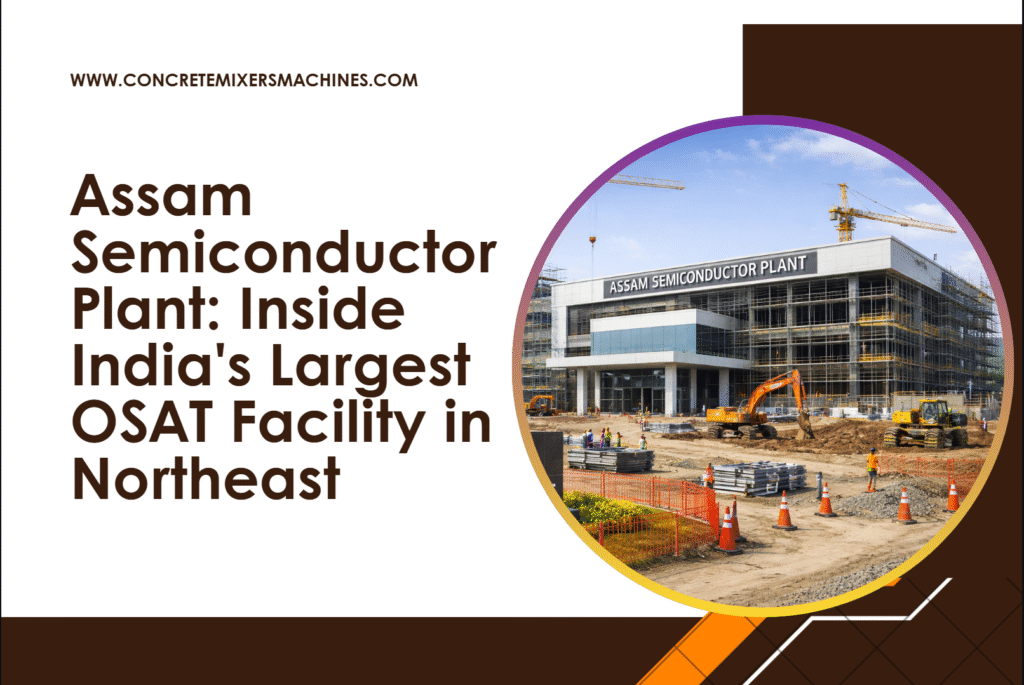
India’s semiconductor journey has reached a transformative milestone with the establishment of the Tata Semiconductor Assembly and Test facility in Jagiroad, Assam. This groundbreaking project represents more than just technological advancement—it signals a new era of industrial growth and infrastructure development for Northeast India and the entire nation.
As manufacturers and infrastructure developers in Assam, understanding this semiconductor revolution helps us recognize the massive construction and industrial opportunities emerging in our region. The semiconductor ecosystem requires robust infrastructure, reliable machinery, and strategic construction support—areas where local expertise becomes invaluable.
What is the Assam Semiconductor Plant?
The Assam semiconductor plant, officially known as Tata Semiconductor Assembly and Test Private Limited (TSAT), is India’s first indigenous and greenfield semiconductor assembly and test facility. Located in Jagiroad, Morigaon district, approximately 55 kilometers from Guwahati, this facility represents a massive investment of ₹27,000 crore (approximately USD 3.6 billion) and marks a historic leap in India’s technological self-reliance journey.
The foundation stone for this revolutionary project was laid on August 3, 2024, in a ceremony attended by Assam Chief Minister Himanta Biswa Sarma and Tata Sons Chairman N. Chandrasekaran. The project received official approval from the Union Cabinet, chaired by Prime Minister Narendra Modi, on February 29, 2024, as part of India’s ambitious Semiconductor Mission.
The facility is being established at the erstwhile Hindustan Paper Corporation’s Nagaon Paper Mill premises, transforming a previously non-operational industrial site into a cutting-edge semiconductor manufacturing hub. This strategic location choice demonstrates how Assam is emerging as a key player in India’s high-tech manufacturing landscape.
The Scale and Scope of the Jagiroad Semiconductor Facility
The Tata semiconductor facility in Jagiroad operates on an impressive scale that positions it among the most ambitious projects in India’s industrial history. The plant is being developed across a sprawling 171-acre campus equipped with state-of-the-art infrastructure utilizing renewable energy sources.
Production Capacity and Technology
The facility is designed to produce an astounding 48 million chips per day, which translates to over 4.83 crore chips daily. This massive output capacity will serve diverse applications across multiple industries including:
- Artificial Intelligence systems
- Mobile technology
- Cloud storage infrastructure
- Internet of Things (IoT) devices
- Automotive electronics
- Radio frequency applications
The plant will house over 1 million square feet of cleanroom space featuring advanced packaging technologies. Tata Electronics is implementing three cutting-edge packaging technologies with plans for expansion, including wire bond, integrated system packaging (ISP), and flip chip technologies.
Employment and Economic Impact
The economic ripple effects of this facility extend far beyond chip production. The project is expected to generate over 25,000 direct and indirect jobs in the region, creating employment opportunities for engineers, technicians, operators, and support staff. This massive workforce requirement has already triggered significant training and skill development initiatives across Assam.
For local businesses, particularly in construction and machinery sectors, this translates to sustained demand for infrastructure support, logistics, equipment maintenance, and various ancillary services over the coming decades.
India’s Semiconductor Mission: The Bigger Picture
The Assam semiconductor plant operates within the framework of India’s ambitious Semiconductor Mission, launched with a total outlay of ₹76,000 crore. This national initiative aims to establish India as a global semiconductor manufacturing hub and reduce dependence on imports.
Approved Facilities Across India
As of 2025, India has approved ten semiconductor projects across six states with cumulative investments of around ₹1.60 lakh crore. Here’s a snapshot of major facilities:
Gujarat Semiconductor Hub:
- Micron Technology in Sanand (₹22,516 crore) – Assembly, Test, Mark and Pack (ATMP) facility
- CG Power & Industrial in Sanand (₹7,600 crore) – 15 million chips per day capacity
- Kaynes Semicon in Sanand (₹3,307 crore) – 6.33 million chips per day
- Tata Electronics in Dholera (₹91,000 crore) – 50,000 wafers per month
Other Strategic Locations:
- HCL-Foxconn JV in Jewar, Uttar Pradesh (₹3,700 crore)
- SicSem Private Limited in Bhubaneshwar, Odisha (₹2,066 crore)
- 3D Glass Solutions in Bhubaneshwar, Odisha (₹1,943 crore)
- CDIL in Mohali, Punjab (₹117 crore)
- ASIP in Andhra Pradesh (₹468 crore)
Among these facilities, the Assam semiconductor plant stands out as the largest ATMP facility by capacity and represents the most significant industrial project ever undertaken in Northeast India.
Why Assam for Semiconductor Manufacturing?
The selection of Jagiroad, Assam for this mega semiconductor facility wasn’t arbitrary. Several strategic factors made Assam an ideal location:
Geographic and Strategic Advantages
Assam’s location in Northeast India provides unique strategic advantages. The state serves as a gateway to Southeast Asian markets while maintaining strong connectivity with major Indian industrial hubs. The proximity to Guwahati, a rapidly developing smart city and regional commercial center, provides access to skilled manpower, logistical infrastructure, and support services.
Infrastructure and Connectivity
The semiconductor facility benefits from Assam’s improving infrastructure landscape. Recent developments in road connectivity, airport facilities, and digital infrastructure have transformed the state’s industrial readiness. The plant’s location near major transportation networks facilitates efficient movement of materials and finished products.
Government Support and Policy Framework
Assam’s Electronics Policy provides comprehensive support for semiconductor manufacturing, including incentives for land acquisition, power subsidies, and facilitation of approvals. The state government has demonstrated strong commitment through the swift allocation of the erstwhile paper mill premises and coordination with central agencies.
Renewable Energy Integration
One of the distinguishing features of the Assam facility is its commitment to sustainability. The plant utilizes renewable energy for operations, aligning with India’s broader environmental goals while ensuring long-term operational sustainability. This focus on clean energy makes the facility future-ready and environmentally responsible.
Construction and Infrastructure Implications for Assam
The semiconductor facility’s development has triggered unprecedented infrastructure activity across Assam. This construction boom presents significant opportunities for businesses involved in building materials, machinery, and industrial equipment.
Immediate Construction Requirements
The development of a 171-acre high-tech manufacturing campus requires massive civil engineering work including:
- Foundation preparation for heavy machinery installations
- Specialized flooring for cleanroom facilities
- HVAC and environmental control systems
- Water treatment and supply infrastructure
- Power distribution and backup systems
- Security and perimeter infrastructure
Each of these requirements demands reliable construction equipment, including concrete mixers, material handling systems, and specialized machinery capable of meeting exacting industrial standards.
Ongoing Infrastructure Support
Beyond initial construction, the facility requires continuous infrastructure support for:
- Maintenance of cleanroom environments
- Expansion of production lines
- Development of ancillary facilities
- Employee housing and amenities
- Logistics and warehousing infrastructure
Regional Development Impact
The semiconductor plant acts as a catalyst for broader regional development. Supporting industries are establishing operations near the facility, creating demand for:
- Industrial parks and manufacturing zones
- Transportation infrastructure improvements
- Commercial and residential real estate development
- Logistics and warehousing facilities
- Utility infrastructure expansion
For businesses in construction machinery and industrial equipment, this represents sustained demand spanning decades. The need for reliable concrete mixing solutions, material handling equipment, and construction support services will only intensify as the semiconductor ecosystem expands.
The Technology Behind Semiconductor Assembly and Test
Understanding the semiconductor assembly and test process helps appreciate the sophisticated infrastructure requirements of such facilities.
Key Processes in OSAT Facilities
Outsourced Semiconductor Assembly and Test (OSAT) facilities like the one in Jagiroad perform critical functions in the semiconductor supply chain:
- Package Design: Determining how integrated circuits are interconnected and encapsulated for optimal electrical performance, thermal management, and reliability.
- Wafer/Die Preparation: Transforming silicon wafers containing integrated circuits into separate functional chips through thinning, singulation, and preparation processes.
- Interconnection: Establishing electrical connections between IC dies and external systems using techniques like wire bonding, flip-chip, or through-silicon vias (TSVs).
- Finishing: Molding or encapsulating dies for protection, followed by deflashing, laser marking for identification, and singulation to create individual units.
- Testing: Comprehensive verification that integrated circuits function as intended, remain reliable throughout their lifespan, and meet all performance specifications.
- Failure Analysis & Reliability: Systematic investigation of failures and evaluation of performance under operational stresses to ensure long-term durability.
Infrastructure Requirements for Semiconductor Manufacturing
These sophisticated processes require extremely controlled environments and robust supporting infrastructure:
- Cleanroom Facilities: Maintaining particle-free environments with precise temperature and humidity control
- Specialized Utilities: Ultra-pure water systems, specialized gases, and chemical handling infrastructure
- Heavy-Duty Foundations: Supporting precision equipment that tolerates zero vibration
- Advanced HVAC Systems: Maintaining exact environmental conditions throughout massive facilities
- Backup Power Systems: Ensuring uninterrupted operations for sensitive manufacturing processes
Each of these requirements translates to specific needs for construction equipment and materials. High-quality concrete work, precise foundation laying, and reliable material handling become critical success factors.
Timeline and Development Progress
The Assam semiconductor plant is progressing on an accelerated timeline that reflects the urgency of India’s semiconductor ambitions.
Key Milestones
February 29, 2024: Union Cabinet approval for the project with ₹27,000 crore investment commitment.
July 29, 2024: Pre-construction meeting held at Janata Bhawan with officials from Tata Group and Assam state government.
August 3, 2024: Groundbreaking ceremony (Bhumi Pujan) officially launching construction, attended by Chief Minister Himanta Biswa Sarma and Tata Sons Chairman N. Chandrasekaran.
Mid-2025 (Projected): First phase operational readiness, marking the beginning of trial production and customer qualification.
2026 and Beyond: Progressive ramp-up to full production capacity of 48 million chips per day, with ongoing expansion of capabilities and technologies.
Current Status
Construction is progressing rapidly at the site. The transformation of the erstwhile paper mill premises into a world-class semiconductor facility involves extensive site preparation, foundation work, and installation of specialized infrastructure. The accelerated timeline reflects both the national priority status of the project and Tata’s commitment to meeting India’s semiconductor goals.
The Broader Impact on Northeast India
The semiconductor facility represents a watershed moment for Northeast India’s industrial development. Historically, the region has lagged behind other parts of India in heavy industry and high-tech manufacturing. This project changes that narrative fundamentally.
Catalyzing Industrial Growth
The facility’s establishment has already triggered interest from other high-tech manufacturers and supporting industries. Companies evaluating expansion into Northeast India now see viable supply chains, skilled workforce availability, and proven industrial infrastructure—factors that were uncertain just years ago.
Skills Development and Education
To support the semiconductor industry, Assam and neighboring states are witnessing unprecedented investment in technical education and skills training. Initiatives include:
- Partnership between Tata Electronics and educational institutions like SASTRA University for M.Tech programs in VLSI
- Collaboration with IIM Mumbai for Executive MBA in Manufacturing Management
- State-level training programs in semiconductor technologies
- Hands-on training programs, including sending Indian engineers to Malaysia for three-month skill development courses
These educational initiatives create a skilled workforce that benefits not just the semiconductor industry but the entire regional manufacturing ecosystem.
Economic Transformation
The economic multiplier effect of the ₹27,000 crore investment extends across multiple sectors:
- Construction and real estate experiencing sustained demand
- Logistics and transportation infrastructure expansion
- Hospitality and service sectors growing to support increased business activity
- Retail and consumer markets expanding with rising employment and incomes
- Banking and financial services developing specialized industrial financing capabilities
For businesses operating in Assam, this represents a fundamental shift in the regional economy’s scale and sophistication.
Opportunities for Local Industries and Businesses
The semiconductor ecosystem creates specific opportunities for various business segments, particularly those involved in construction, manufacturing, and infrastructure.
For Construction Equipment Suppliers
The ongoing and future construction requirements at the semiconductor facility and supporting infrastructure create sustained demand for:
- Concrete Mixers: High-capacity, reliable mixing equipment for continuous large-scale construction projects
- Material Handling Equipment: Efficient systems for moving construction materials across extensive sites
- Specialized Construction Machinery: Equipment capable of meeting the precision requirements of high-tech facility construction
Businesses positioned to deliver reliable, high-quality construction equipment find ready markets not just at the semiconductor facility but across the expanding industrial landscape.
For Manufacturing and Processing Equipment
The semiconductor facility requires supporting manufacturing for packaging materials, chemical supplies, and various consumables. This creates opportunities for:
- Processing equipment suppliers
- Materials manufacturing
- Precision engineering services
- Quality testing and calibration services
For Infrastructure and Utility Services
Maintaining and expanding infrastructure around the facility requires:
- Civil engineering contractors
- Electrical and mechanical system installers
- Environmental management services
- Facility maintenance providers
Strategic Partnerships and Technology Transfer
The Assam semiconductor plant benefits from strategic partnerships that bring global expertise to Indian manufacturing.
Technology Collaborations
Tata Electronics has established partnerships with leading global semiconductor companies and institutions:
- Powerchip Semiconductor Manufacturing Corp (PSMC) of Taiwan for its Dholera facility
- Collaborations with equipment manufacturers for advanced packaging technologies
- Partnerships with academic institutions for research and development
Talent Development Initiatives
The facility participates in India’s broader semiconductor talent development programs:
- Access to government-supported Electronic Design Automation (EDA) tools for chip design
- Participation in the C2S program benefiting 278 academic institutions
- Contribution to training programs targeting 85,000 skilled professionals in semiconductor design
These partnerships ensure the facility operates at global standards while building indigenous capabilities that benefit India’s entire semiconductor ecosystem.
India’s Semiconductor Self-Reliance Journey
The Assam facility fits into India’s broader strategy for semiconductor self-reliance, reducing dependence on imports from countries like Taiwan, China, and South Korea.
From Consumer to Producer
India has traditionally been a major consumer of semiconductors, importing chips worth billions of dollars annually. The establishment of facilities like the one in Jagiroad begins India’s transformation from consumer to producer, with strategic implications for:
- National security and defense technology independence
- Economic resilience in critical technology sectors
- Global supply chain participation
- Technology innovation and intellectual property development
Indigenous Technology Development
India is developing several indigenous capabilities:
- First indigenous semiconductor chip ready for production in 2025
- Advanced 3-nanometer chip design centers in Noida and Bengaluru
- Movement from traditional Silicon-based to advanced Silicon Carbide semiconductors
- Introduction of advanced 3D Glass packaging technology
The Jagiroad facility will manufacture chips using these indigenous technologies, demonstrating India’s growing capability across the semiconductor value chain.
Environmental Sustainability and Corporate Responsibility
Modern semiconductor manufacturing emphasizes environmental sustainability, and the Assam facility incorporates several green initiatives.
Renewable Energy Integration
The facility’s commitment to renewable energy for operations reduces environmental impact while ensuring long-term sustainability. This approach includes:
- Solar power generation capabilities
- Energy-efficient manufacturing processes
- Water recycling and conservation systems
- Waste management and recycling protocols
Community Development
Tata’s presence in Jagiroad extends beyond manufacturing to include community development initiatives:
- Skills training for local youth
- Support for educational institutions
- Infrastructure development in surrounding areas
- Healthcare and social welfare programs
These initiatives ensure the facility contributes positively to the broader community while building strong local relationships.
Comparative Analysis: Assam vs Other Semiconductor Hubs
Understanding how the Assam facility compares to other semiconductor projects provides context for its significance.
Capacity Comparison
With 48 million chips per day capacity, the Jagiroad facility ranks as:
- The largest ATMP facility by daily production capacity in India
- Significantly larger than the CG Power facility in Sanand (15 million chips/day)
- Comparable to major global OSAT facilities in Malaysia and Vietnam
Investment Scale
The ₹27,000 crore investment represents:
- The largest single industrial investment in Northeast India
- Approximately 30% of the total semiconductor investment under India’s Semiconductor Mission
- A commitment level that signals confidence in the region’s industrial potential
Strategic Positioning
Unlike facilities in traditional industrial hubs like Gujarat and Uttar Pradesh, the Assam facility:
- Pioneers high-tech manufacturing in Northeast India
- Creates new supply chain routes and logistics networks
- Demonstrates government commitment to regional balance in industrial development
The Future: What’s Next for Assam’s Semiconductor Ecosystem?
The Tata facility represents just the beginning of Assam’s semiconductor journey. Several developments suggest a bright future:
Potential Expansions
Industry analysts predict:
- Additional capacity expansion at the existing facility beyond initial plans
- Establishment of supporting component manufacturing
- Development of a semiconductor ecosystem with multiple players
- Integration with electronics manufacturing initiatives
Technological Advancement
Future capabilities may include:
- Advanced packaging technologies beyond current offerings
- Integration of AI-enabled manufacturing processes
- Development of specialized chips for emerging applications
- Research and development facilities for next-generation technologies
Regional Integration
The facility will likely catalyze:
- Development of semiconductor-related industries across Northeast India
- Establishment of specialized industrial zones
- Creation of training and research institutions
- Growth of a skilled workforce ecosystem supporting high-tech manufacturing
How This Impacts Construction and Industrial Equipment Sectors
For businesses in construction machinery and industrial equipment, the semiconductor facility’s implications are both immediate and long-term.
Immediate Market Opportunities
The construction phase creates immediate demand for:
- Concrete batching plants capable of producing specialized concrete for cleanroom construction
- Self-loading concrete mixers for efficient material handling across the extensive campus
- Reversible drum mixers for various construction applications
- Hydraulic hopper concrete mixer machines for specialized applications
- Concrete mixers with lift for multi-level construction needs
Sustained Demand Drivers
Beyond initial construction, the facility generates ongoing demand through:
- Maintenance and repair of infrastructure
- Expansion of existing facilities
- Development of supporting infrastructure
- Growth of ancillary industries requiring similar equipment
Quality and Reliability Requirements
Semiconductor manufacturing demands extraordinary precision and reliability in all supporting infrastructure. This creates opportunities for suppliers who can demonstrate:
- Consistent quality in materials and equipment
- Reliability under continuous operation
- Technical support and rapid service response
- Understanding of specialized industrial requirements
Strategic Recommendations for Businesses in Assam
For businesses looking to capitalize on the semiconductor-driven growth, several strategic considerations apply:
Building Capabilities
Companies should focus on:
- Upgrading equipment to meet industrial-grade specifications
- Developing expertise in specialized construction techniques
- Building service networks for rapid response
- Establishing relationships with major contractors and developers
Market Positioning
Strategic positioning includes:
- Emphasizing local presence and understanding of regional conditions
- Highlighting experience with large-scale industrial projects
- Demonstrating commitment to quality and reliability
- Building partnerships with established players in construction and manufacturing
Innovation and Adaptation
Success requires:
- Staying current with technological requirements in modern industrial construction
- Adapting traditional equipment and methods to meet new standards
- Investing in training and skill development
- Embracing digital tools for project management and coordination
Conclusion: A New Era for Assam and Northeast India
The Tata Semiconductor Assembly and Test facility in Jagiroad represents far more than a manufacturing plant. It symbolizes India’s technological ambitions, demonstrates the government’s commitment to balanced regional development, and creates unprecedented opportunities for businesses across Northeast India.
For companies in the construction and industrial equipment sectors, this marks the beginning of a sustained growth period. The semiconductor facility will operate for decades, continuously requiring infrastructure support, expansion, and maintenance. Supporting industries will establish operations throughout the region, each with their own construction and equipment needs.
The transformation of Assam from a traditionally agricultural economy to a high-tech manufacturing hub is underway. Businesses positioned to support this transformation with reliable equipment, quality service, and deep understanding of industrial requirements will find themselves at the center of Northeast India’s greatest economic opportunity in generations.
As the facility moves toward its 2025 operational target and beyond, the entire regional economy will benefit from the jobs, skills, infrastructure, and industrial ecosystem it creates. The semiconductor revolution has arrived in Assam, and its impact will be felt across every sector of the economy for decades to come.
For manufacturers and suppliers of construction equipment, industrial machinery, and supporting services in Assam, the message is clear: the time to prepare, invest, and position for this opportunity is now. The semiconductor ecosystem doesn’t just need chips—it needs the robust infrastructure, reliable equipment, and committed local partnerships that will make it successful for years to come.