
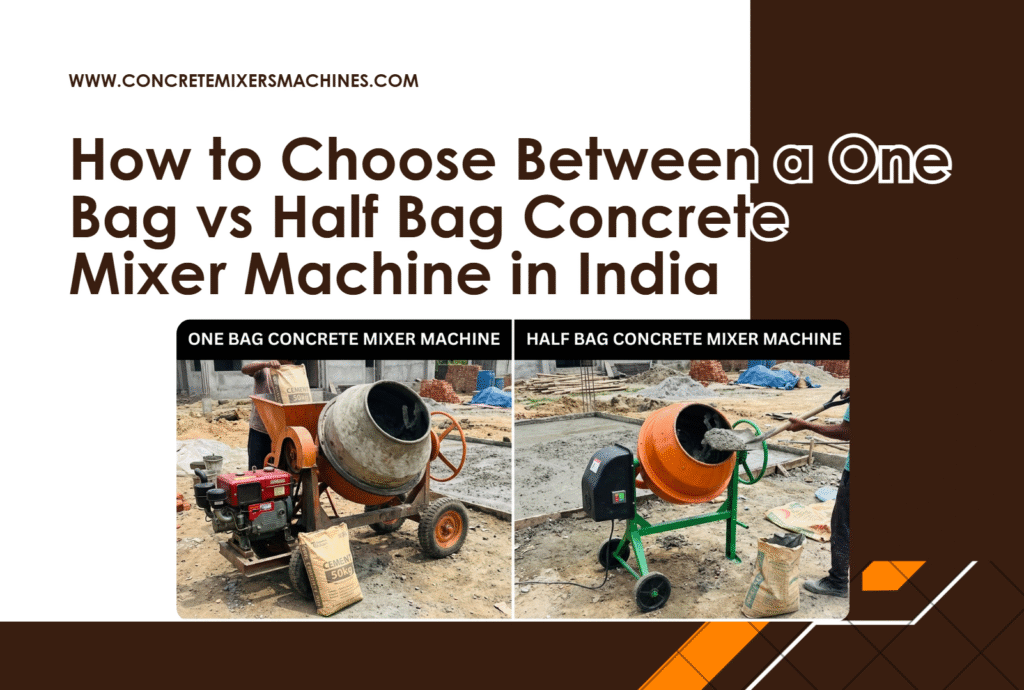
One bag vs half bag concrete mixer machine — this is the single most important equipment decision on any Indian construction site, and most buyers get it wrong. They pick the first machine available instead of the right machine for their specific project.
Walk onto any active construction site in Guwahati, Assam, or across North-East India, and you will find a concrete mixer running. But a machine that is too small for your project kills productivity. A machine that is too large for a minor repair job wastes your investment. The wrong choice costs you time, money, and labour.
What Is a Half Bag Concrete Mixer Machine?
A half bag concrete mixer machine — also called a mini concrete mixer or portable concrete mixer — is designed to mix ingredients for half a bag of cement (approximately 25 kg) per batch.
Key Specifications of a Half Bag Concrete Mixer
- Drum Capacity: 200–250 litres (unmixed volume)
- Mixing Output: Approx. 100 litres per batch
- Power Options: 2 HP electric motor or diesel engine
- Machine Weight: 130–350 kg depending on model
- Typical Price Range in India: ₹30,000 to ₹60,000
What Is a Half Bag Concrete Mixer Best Suited For?
- Residential repairs — driveways, pathways, compound walls
- Small renovation projects and floor topping work
- Remote or constrained sites with limited access
- DIY homebuilding in rural or semi-urban areas
- Sites where ready-mix concrete delivery is unavailable
What Is a One Bag Concrete Mixer Machine?
A one bag concrete mixer machine handles a full 50 kg bag of cement per batch. It is the standard workhorse for mid-scale and large construction projects across India. The most common configuration is the 10/7 CFT model — 10 cubic feet total drum volume with a usable mixing capacity of 7 cubic feet (approximately 200 litres of mixed concrete).
Key Specifications of a One Bag Concrete Mixer
- Drum Capacity: 280–300 litres (unmixed volume)
- Mixing Output: Approx. 200 litres per batch
- Power Options: 5–7.5 HP diesel engine or electric motor
- Machine Weight: 680–800 kg
- Typical Price Range in India: ₹80,000 to ₹1,50,000+
What Is a One Bag Concrete Mixer Best Suited For?
- Multi-floor residential and commercial construction
- RCC work — columns, beams, slabs, staircases
- Foundation work requiring continuous high-output mixing
- Construction projects with multiple trades working simultaneously
- Contractors managing medium to large sites across North-East India
One Bag vs Half Bag Concrete Mixer Machine: Side-by-Side Comparison
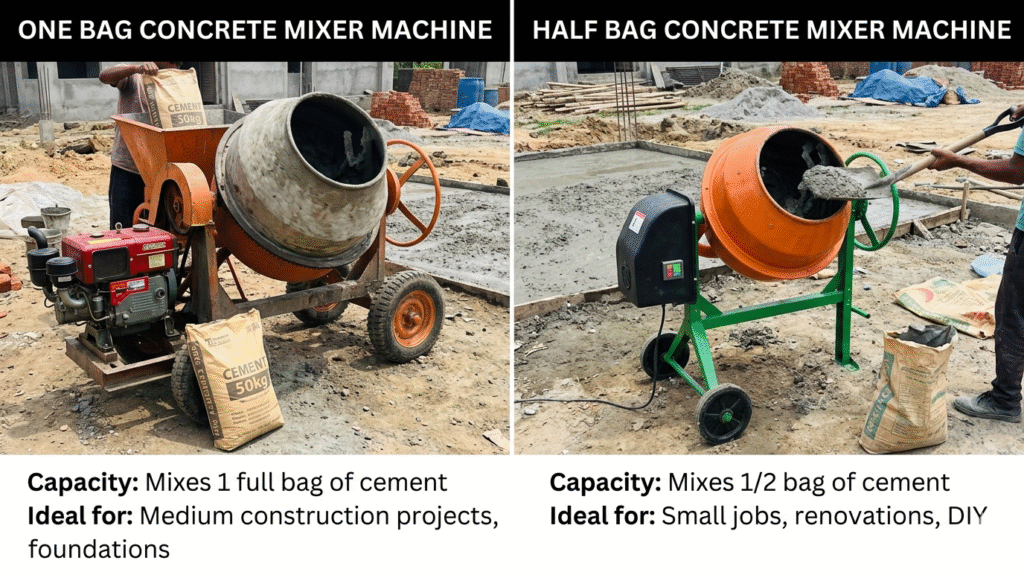
Here is a clear breakdown so you can compare both machines at a glance:
| Feature | Half Bag Concrete Mixer | One Bag Concrete Mixer |
| Drum Capacity | 200–250 Litres (unmixed) | 280–300 Litres (unmixed) |
| Mixing Output | ~100 Litres per batch | ~200 Litres per batch |
| Cement per Batch | Half bag (25 kg) | Full bag (50 kg) |
| Power Source | Electric motor (2 HP) or Diesel | Diesel engine (5–7.5 HP) or Electric |
| Weight (approx.) | 130–350 kg | 680–800 kg |
| Portability | High – easy to shift on site | Moderate – chassis with wheels |
| Price Range (India) | ₹30,000 – ₹60,000 | ₹80,000 – ₹1,50,000+ |
| Best For | Small repairs, renovations, DIY | Multi-floor construction, RCC work |
| Labour Needed | 1–2 operators | 2–3 operators |
Price Comparison: 1 Bag vs Half Bag Concrete Mixer Machine in India
Budget is always a key factor on any site. Here is how the pricing typically breaks down in India and specifically in North-East India:
- Half Bag Electric Motor Model: ₹30,000 – ₹46,000
- Half Bag Diesel Engine Model: ₹46,000 – ₹60,000
- One Bag Without Hopper (Electric): ₹80,000 – ₹1,00,000
- One Bag With Hydraulic Hopper (Diesel): ₹1,00,000 – ₹1,50,000+
The right choice is not always the cheaper one. A half bag machine bought for a large project will cost you more in time and labour than the investment in a one bag model. Plan for total cost of output — not just purchase price.
One Bag vs Half Bag: The North-East India Angle
Construction sites in Assam, Meghalaya, Nagaland, and neighbouring states face unique challenges that affect machine selection:
- Hilly and Remote Terrain: Sites in the hills require highly portable machines. A half bag mixer can be carried and repositioned easily. A one bag machine needs a reasonably flat, accessible surface.
- Lack of Ready-Mix Access: Ready-mix concrete (RMC) availability is limited outside Guwahati. Both one bag and half bag mixers fill this gap, but the one bag machine is better for continuous production on larger projects.
- Smaller Crew Sizes: Many residential sites in North-East India operate with lean labour. The half bag machine is easier for 1–2 operators to run efficiently, while a one bag setup works best with 2–3 people.
- Budget Considerations: For contractors balancing multiple small projects, owning a half bag machine is a more flexible investment. For developers running single large projects, the one bag model delivers better ROI.
How to Decide: A Simple Framework
Still unsure? Use this decision framework:
- What is the scale of your project?
Small repairs, extensions, or compound walls → go with a half bag. Multi-floor or commercial construction → go with a one bag.
- How accessible is your site?
Narrow access, upper floors, or hilly areas → half bag wins on portability. Ground-level, open sites → one bag machine handles output efficiently.
- How many workers are on your crew?
1–2 operators → half bag is easier to manage. 2–3 operators → one bag machine is fully justified.
- What is your daily concrete output target?
Low daily output (under 1 cubic metre) → half bag. Higher output (1–3+ cubic metres daily) → one bag or consider a hydraulic hopper model.
What Experts Say About Concrete Mixer Selection
Selecting the right type of concrete mixer depends primarily on the volume of concrete required, the nature of the project, and site conditions. Smaller projects benefit from portable drum mixers, while larger, continuous-pour projects demand higher-capacity units with hopper loading systems.
The Bureau of Indian Standards (BIS) also recommends that concrete for RCC structural elements — columns, beams, and slabs — be mixed using mechanically operated drum mixers to ensure uniform consistency and minimum water-cement ratio compliance. This is precisely where the one bag concrete mixer machine earns its place on mid-to-large construction sites.
This aligns with what contractors across North-East India consistently find on the ground. A half bag machine is a versatile workhorse for everyday residential work; a one bag machine is the backbone of structured construction that demands consistent RCC-grade output.
Conclusion: The Right Machine Makes All the Difference
There is no single best concrete mixer machine — there is only the right one for your specific project, site, and budget. The half bag concrete mixer is powerful enough for small-scale and portable use, while the one bag concrete mixer is the natural choice for anyone serious about sustained construction output.
Do not guess. Get expert guidance. Contact us today to find the right machine for your next project.
📞 Get a Free Quote | View our concrete mixer machines at concretemixersmachines.com | Serving Guwahati & all of North-East India since 2009.
Frequently Asked Questions
Q1. What is the main difference between a one bag and half bag concrete mixer?
The core difference is capacity. A half bag mixer processes 25 kg of cement (about 100 litres of concrete) per batch. A one bag mixer handles a full 50 kg bag of cement (about 200 litres per batch). This doubles the output per cycle and significantly affects productivity on larger sites.
Q2. Which is better for a residential house construction in Assam?
For a standard G+1 or G+2 residential home in Assam, a one bag concrete mixer machine is typically the better investment. It provides enough output for RCC columns, beams, and slabs without over-stressing the mixer. For minor finishing or repair work on an existing home, a half bag model is more practical.
Q3. What is the price of a 1 bag concrete mixer machine in India?
The price of a one bag concrete mixer machine in India typically ranges from ₹80,000 to ₹1,50,000 depending on whether it has a hydraulic or mechanical hopper, the engine brand, and the dealer location. In North-East India, Lotus Traders offers competitive pricing with direct manufacturer support.
Q4. Is a half bag concrete mixer machine suitable for RCC work?
Technically, yes — but practically, it is not recommended for large RCC pours. The lower output means more frequent batches, which can affect the consistency of the pour and slow down your construction schedule significantly. For RCC columns, slabs, and beams, a one bag machine is the standard choice.
Q5. Can I use a half bag mixer machine for commercial projects?
A half bag mixer can be used for small commercial projects such as boundary walls, pathways, or petty repairs on commercial buildings. For primary commercial construction work involving structural elements, a one bag or higher capacity machine is more appropriate.
Q6. What power source is better — electric motor or diesel engine for a concrete mixer?
Electric motors are quieter, cost less to operate, and are ideal for sites with a reliable power supply. Diesel engine concrete mixers are the better choice for remote sites, hilly terrain, or locations where electricity is inconsistent — conditions common across many parts of North-East India.
Q7. Where can I buy a concrete mixer machine in Guwahati?
Lotus Traders