
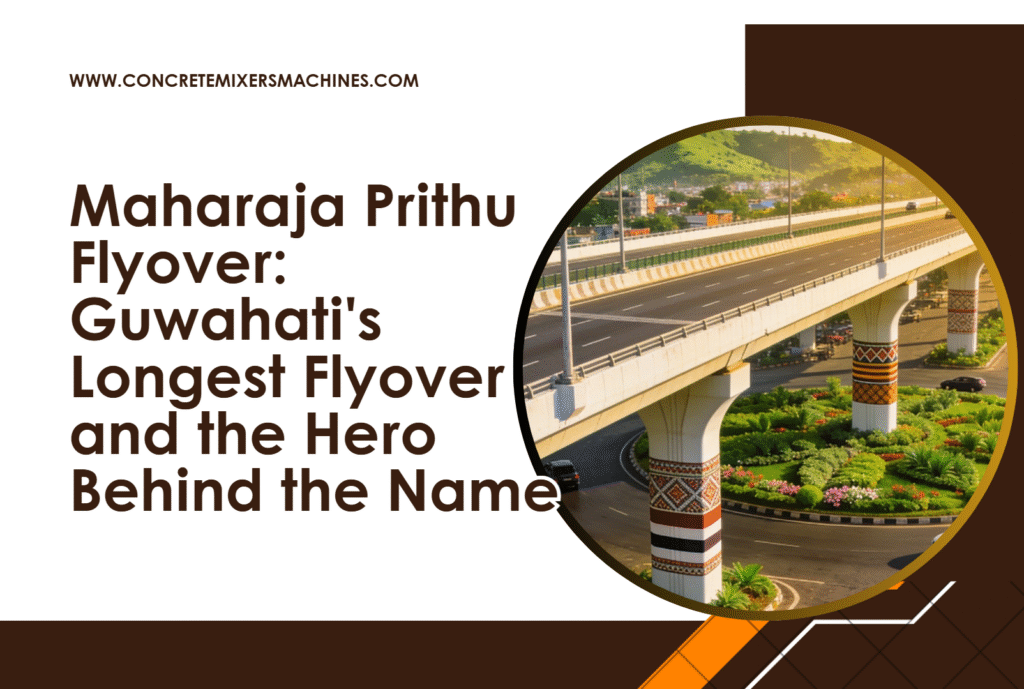
Guwahati just got a landmark upgrade — and it comes with a powerful story. The Maharaja Prithu Flyover, inaugurated in March 2026, is now the longest flyover not just in Assam, but in the entire Northeast India. Stretching approximately 4.2 kilometres along the busy GNB Road corridor, this Rs 852 crore four-lane elevated highway links Noonmati in the east with Dighalipukhuri in the heart of the city, passing through key junctions like Ambari, Chandmari, and Bamunimaidam.
But beyond the concrete and steel lies a story worth telling. The flyover is named after Maharaja Prithu, a 13th-century warrior king of the Kamarupa kingdom (modern-day Assam) who defeated the Turko-Afghan invader Bakhtiyar Khilji in 1206 CE — the same general who destroyed the famed Nalanda University. In a single stroke, Assam’s government has combined infrastructure with heritage in what Chief Minister Himanta Biswa Sarma describes as “Vikas bhi, Virasat bhi” — development alongside legacy.
Whether you are a Guwahati commuter, a history enthusiast, or someone tracking India’s urban infrastructure growth, this article covers everything you need to know about the Maharaja Prithu Flyover — its specs, its significance, and the remarkable king who inspired its name.
What Is the Maharaja Prithu Flyover?
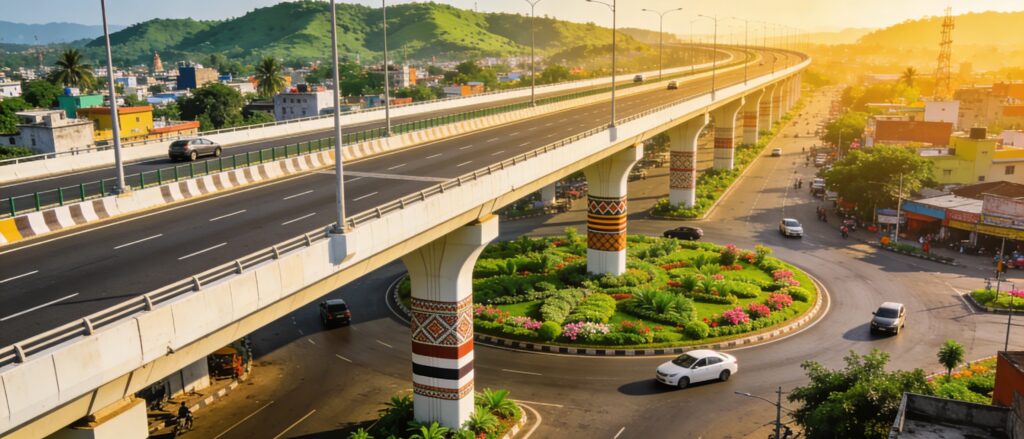
The Maharaja Prithu Flyover, also referred to as the Noonmati–Dighalipukhuri Flyover, is a four-lane elevated road corridor built along GNB (Gopinath Bordoloi) Road — one of Guwahati’s busiest traffic arteries. It officially became Guwahati’s 30th flyover upon inauguration and stands as the longest flyover in Assam and the broader Northeast India region.
Key Facts at a Glance
- Length: Approximately 4.2 km (some reports cite up to 5.5 km including connecting stretches)
- Lanes: Four-lane (two in each direction)
- Cost: Rs 852.68 crore
- Construction time: 28 months (completed ahead of 36-month deadline)
- Pillars: 129 pillars with steel girder superstructure
- Route: Bamunimaidam (east) → Ambari → Chandmari → Dighalipukhuri (west)
- Connection: Linked to the existing Chandmari flyover for seamless vehicle movement
- Under-flyover space: Repurposed as parking areas to reduce roadside congestion
The flyover was inaugurated by Assam Chief Minister Himanta Biswa Sarma on March 11, 2026, with a three-day pedestrian-only walking zone before full vehicular movement began — a rare civic gesture that allowed residents to experience the structure firsthand.
Why Was It Named After Maharaja Prithu?
Naming public infrastructure after historical figures is not new in India. But the choice of Maharaja Prithu carries deep symbolic weight — particularly in Assam, where regional pride and the preservation of cultural memory run strong.
Maharaja Prithu, also known as Visvasundaradeva or Prithu Rae, ruled the Kamarupa kingdom from approximately 1185 to 1228 CE. He is best known for his decisive military victory over Muhammad bin Bakhtiyar Khilji in 1206 CE — a battle that historians now celebrate as the Battle of Kamarupa.
CM Sarma explained the naming decision: “Maharaja Prithu was not just a ruler but a symbol of resistance and courage. Naming this flyover after him is a tribute to Assam’s rich historical heritage.” He also noted that the decision aligns with Prime Minister Narendra Modi’s emphasis on “Vikas bhi, Virasat bhi” — acknowledging that modern development and historical memory must walk hand in hand.
Who Was Maharaja Prithu? The Warrior King of Kamarupa
Few figures in Indian history have been as overlooked as Maharaja Prithu of Kamarupa. While much of India fell to successive waves of Turko-Afghan invasions in the 12th and 13th centuries, Assam stood firm — largely because of this warrior king.
The Battle That Stopped Bakhtiyar Khilji
By 1206 CE, Bakhtiyar Khilji had already ravaged Nalanda and Vikramashila universities, massacring monks and scholars across Bihar and Bengal. Emboldened by these conquests, he set his sights on Tibet, planning to pass through Kamarupa with an army of 12,000 cavalry and 20,000 infantry soldiers.
Maharaja Prithu, fully aware of the approaching threat, deployed a brilliant multi-pronged strategy:
- Scorched Earth Policy: He destroyed food supplies, agricultural land, and water sources along Khilji’s route, systematically starving the invading army.
- Coalition Warfare: Prithu united the Bodo, Koch Rajbongshi, and Keot tribal communities into a single fighting force.
- Destroyed the Bridge: After Khilji’s army had crossed the Barandi River, Prithu’s forces destroyed the bridge, cutting off their retreat.
- Relentless Pursuit: As Khilji’s forces attempted to retreat, Prithu attacked from all sides, killing thousands.
Khilji escaped with barely a hundred men. Broken and humiliated, he never led another battle and was assassinated by his own general Ali Mardan shortly after. The Kanai Boroxiboa Rock Inscription in North Guwahati, written in Sanskrit, commemorates this victory to this day.
This historic triumph is celebrated every year in Assam as Mahavijay Diwas on March 27 — the 13th day of Chaitra in the Saka calendar.
How the Maharaja Prithu Flyover Will Transform Guwahati
GNB Road handles thousands of vehicles daily and has long been one of Guwahati’s most congested traffic corridors. The Maharaja Prithu Flyover directly addresses this urban pain point in several ways:
1. Reduced Travel Time
Commuters travelling between eastern Guwahati (Noonmati area) and the city centre (Dighalipukhuri) previously faced significant delays at the Guwahati Club roundabout and Chandmari junction. The flyover provides a continuous elevated corridor that bypasses both chokepoints entirely.
2. Decongestion of Key Junctions
By lifting a substantial portion of through-traffic off street level, the flyover eases pressure on the road below, benefiting pedestrians, local businesses, and emergency vehicles alike.
3. Environmental Benefits
Lower idling time and reduced stop-and-go traffic are expected to meaningfully cut air and noise pollution along the GNB Road corridor — a welcome relief for residents and businesses in Ambari and Chandmari.
4. No Heavy Vehicle Restrictions
Authorities confirmed that there will be no restrictions on heavy vehicles using the flyover, ensuring uninterrupted movement of goods and freight — critical for Guwahati’s role as a commercial and logistics hub in Northeast India.
5. Smart Use of Under-Flyover Space
The space beneath the flyover’s 129 pillars is being converted into organised parking bays, directly reducing the roadside parking that clogs arterial roads.
Guwahati’s Growing Flyover Network: What Comes Next?
The Maharaja Prithu Flyover is part of a larger infrastructure transformation underway in Guwahati. Speaking at the inauguration, CM Sarma outlined plans that position the city for serious urban mobility upgrades over the next several years.
- Flyover Network Integration: Plans are underway to connect the Ulubari flyover with the Guwahati Club flyover via the Stadium flyover, creating a seamless elevated traffic corridor across central Guwahati.
- Cycle Factory Flyover: Expected to be completed before Bihu 2026.
- Dibrugarh Expansion: Two flyovers already completed; three more under construction.
- Urban Flooding: The government’s next stated priority is tackling chronic urban flooding, with concrete drainage lines from Dighalipukhuri to Noonmati among the planned works.
- Metro Rail: Once the ring road project is complete, the government plans to push forward with metro rail development for Guwahati.
Under CM Sarma’s tenure alone, 12 flyovers have been completed in Guwahati, dramatically transforming the city’s infrastructure profile in a relatively short time.
Construction, Challenges, and Environmental Accountability
Like any large-scale urban infrastructure project, the Maharaja Prithu Flyover was not built without controversy. Environmental activists raised concerns about the felling of trees along the GNB Road corridor during construction.
CM Sarma addressed the criticism directly at the inauguration: “Out of the 70 trees that were uprooted during construction, 68 have been successfully transplanted and are growing well. I invite those who protested the tree felling to visit the Textile Institute campus and see how these trees are being cared for.”
The construction itself began in late 2023 and was completed in 28 months — eight months ahead of the originally planned 36-month schedule. The project’s early completion was attributed to careful planning, constant monitoring, and strong technical execution — setting what CM Sarma called a new benchmark for infrastructure delivery in Assam.
The Symbolism of ‘Vikas bhi, Virasat bhi’
The decision to name Assam’s longest and most expensive flyover after a relatively lesser-known medieval warrior king is a deliberate cultural statement. For decades, Maharaja Prithu’s story — despite being recorded in the Persian chronicle Tabaqat-i-Nasiri and carved in the Kanai Boroxiboa Rock Inscription — remained largely outside mainstream Indian history textbooks.
By placing his name on Northeast India’s most prominent piece of new infrastructure, the Assam government has done something powerful: it has made this forgotten warrior impossible to overlook. Schoolchildren, daily commuters, and visitors from across India will now encounter the name Maharaja Prithu as a natural part of their daily lives.
As CM Sarma noted: “From Maharaja Prithu to Lachit Borphukan, and finally Itakhuli, Assam stood like a wall against one invader after another. While much of India fell to the Khiljis, Tughlaqs, Afghans, and Mughals, Assam never surrendered.”
Conclusion
The Maharaja Prithu Flyover is more than an infrastructure milestone. It is a bridge between Guwahati’s modern ambitions and its ancient legacy — a 4.2-kilometre tribute to a warrior king who once held the line against an invading army and, in doing so, shaped the course of Northeast Indian history.
For Guwahati’s 1.3 million residents, the immediate benefits are tangible: faster commutes, reduced congestion, and cleaner air. For Assam as a whole, the flyover signals something larger — that development and heritage are not competing priorities but complementary ones.
Whether you’re stuck in Chandmari traffic every morning, a student learning about the Battle of Kamarupa, or a business owner in Ambari — the Maharaja Prithu Flyover is now a landmark you’ll be talking about for years to come.
Visit concretemixersmachines.com and explore our range of certified, high-performance concrete mixer machines and construction equipment.